What Are Names for Jesus: A Comprehensive Guide to Epithets, Titles, and Biblical Names
This article explores the spectrum of names for Jesus, from the most common
everyday title to the deeply symbolic epithets that appear in biblical texts, liturgy,
and devotional literature. By tracing the linguistic roots, historical usage, and theological meanings
behind these expressions, readers gain a clearer understanding of who Jesus is believed to be
within Christian faith traditions. Whether you are a student of theology, a curious reader, or
someone preparing a study guide or sermon, this guide offers structure, context, and examples—
all organized to help you remember what are the names for Jesus and why they matter.
Why Names Matter in Biblical Thought
Names in biblical literature are rarely casual. They carry about them a sense of mission,
divine relationship, and community memory. When readers ask what are the names for Jesus,
they are seeking not only a catalog of labels but a map of how early Christians understood
Jesus’ person, work, and destiny. The array of terms reflects several intertwined aims:
Affirming Jesus’ divine identity and his unique status within the Godhead.
Describing Jesus’ earthly role as savior, teacher, and shepherd.
Illustrating Jesus’ messianic expectation in relation to prophecies and covenants.
Providing language for worship, prayer, and proclamation across diverse Christian communities.
In studying the many terms that name Jesus, readers encounter not only distinct words but
different theological emphases—some highlight authority, others highlight compassion, and still
others point to revelation, creation, or eschatological victory. This guide categorizes and
explains these terms, offering concise definitions, etymological notes,
and references to where the terms occur in the biblical text or in traditional liturgy.
Categories of Epithets and Titles
The names and titles given to Jesus can be grouped conceptually. While many terms overlap in meaning,
they each foreground particular aspects of Jesus’ identity or mission. The following sections present
major categories, with representative examples.
These expressions describe who Jesus is by attributes or roles that belong to God or the
divine plan. They are often used in gospel narratives and in early Christian hymns.
Son of God — an affirmation of divine sonship and special relationship to the Father.
Son of Man — a title with roots in prophecy, emphasizing humanity, authority, and suffering.
Lamb of God — a sacrificial image tied to atonement and liberation.
Light of the World — a symbol of guidance, truth, and revelation.
Word (Logos) — the divine reason or principle through which creation and revelation come forth.
Bread of Life — nourishment and sustenance of eternal life.
Water of Life — a symbol of spiritual life and purification.
Messianic and Royal Titles
Several names and titles connect Jesus to the longed-for Messiah and to royal imagery rooted in
Jewish expectation. These expressions emphasize fulfillment of prophecy, sovereignty, and
eternal kingship.
King of Israel and King of Kings — royal authority and cosmic sovereignty.
Prince of Peace — a title highlighting harmony, justice, and reconciliation.
King of Zion — literary and doctrinal image tied to God’s people and heaven.
Titles Emphasizing Supply, Salvation, and Redeeming Work
These names highlight what Jesus accomplishes for humanity, especially in salvation history.
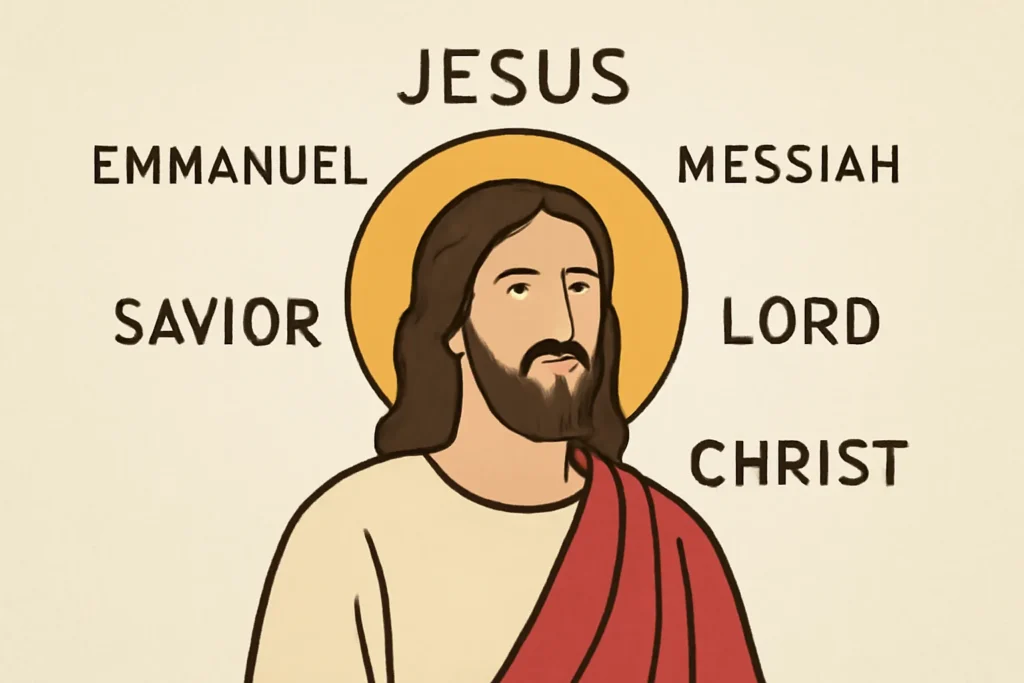
Savior — deliverer from sin and danger.
Redeemer — the one who buys back, reconciles, and restores.
Deliverer — release from bondage, whether spiritual, moral, or existential.
Prophet — teacher and revealer of God’s will and truth.
Titles Related to Creeds, Worship, and Liturgy
In worship, authors and communities name Jesus to address adoration, confession of faith, and
communal memory.
Lord — a central title with intimate, communal, and divine dimensions.
God with us (Emmanuel/Immanuel) — the incarnation as divine presence among people.
High Priest — a priestly mediator in line with Jewish priestly tradition.
Names in the New Testament Languages
Much of what Christians call the names for Jesus comes from the New Testament, where
Greek is the dominant language of the early church. Reading these names in their original
linguistic context deepens understanding of meaning and emphasis.
Jesus, Christ, and Kyrios
Some key terms recur across text and tradition:
Jesus (Iēsous) — the personal name given to Jesus of Nazareth; often linked to
the Hebrew/Yiddish name Yeshua, meaning “the Lord saves.”
Christ (Christos) — a title meaning “anointed one,” designated to Jesus
as fulfillment of messianic expectation.
Lord (Kyrios) — a title used for divinity and sovereignty, used both for Jesus
and, in early church usage, for God the Father. In some texts, it signals recognition of Jesus’
divine status.
Other Greek Epithets and Theological Names
Logos (Word) — the divine reason and source of creation and revelation.
Emmanu-el/Immanuel (Emmanuel, “God with us”) — emphasizes Christ’s incarnation and presence with humanity.
Righteous One — a title that foregrounds moral integrity and role in divine plan.
Names and Their Biblical Citations
While a full concordance is beyond this guide, noting where certain names appear helps readers
connect terms to their biblical contexts. For example, Lamb of God appears in John’s Gospel
and horizons of sacrificial imagery, while Word appears in the prologue of John,
highlighting cosmic significance.
Theological Significance of Names: What Do They Convey?
The array of titles and epithets is not a random catalogue. Each term encodes a set of beliefs about
Jesus’ identity, mission, and relationship to God, creation, and humanity. The way a community
speaks about Jesus can shape devotional practice, creedal formation, and artistic expression.
Identity and divine sonship are reinforced by titles like Son of God and Prince of Peace, which anchor personal identity in cosmic purpose.
Incarnation and presence are emphasized by names such as Emmanuel and God with us, underscoring the belief that the divine took on human form.
Mission and salvation are highlighted by terms like Savior and Redeemer, which point to rescue, forgiveness, and reconciliation.
Worship and doxology are carried by titles such as Lord and King of Kings, inviting adoration, allegiance, and recognition of authority.
It is also worth noting that different Christian traditions emphasize distinct sets of names. For example,
some liturgical traditions place heavy emphasis on titles that highlight Christ’s kingly or priestly roles,
while others foreground the salvific or incarnational aspects. Across these differences, the common thread
is that names for Jesus function as anchors for belief and practice, shaping how communities
understand God’s action in the world.
Contextual Variations Across Traditions
The usage and interpretation of certain names can vary:
Catholic and Orthodox traditions often emphasize titles tied to the liturgical life,
such as King of Peace or Great High Priest, sometimes structuring devotion around Marian and
apostolic titles as well.
Protestant and Evangelical communities may focus more on Christ as Savior, Lord,
or Word, linking names closely to preaching, exegesis, and personal conversion.
Nontrinitarian or interfaith perspectives might treat the term Lamb of God or Messiah
as theological signposts rather than definitive doctrinal statements about the nature of Jesus.
Names in Liturgy and Worship: How the Church Encounters Jesus in Prayer
Names for Jesus are not only academic labels; they live in the church’s songs, prayers, creeds, and
homilies. In many worship traditions, certain titles recur cyclically, weaving a theological
narrative through the service. The following examples illustrate how language shapes devotion.
Cruciform hymns often address Jesus as Crucified Lord or Wounded Healer, reminding
believers of the cross and the healing that flows from it.
Creedal affirmations frequently invoke Lord and Jesus Christ as a compact statement of
faith and the necessity of Christian confession.
Doctrinal prayers may call Jesus the Son of God to emphasize divine identity in intercession.
If you are studying liturgy, observe how the same name can appear in multiple forms across a service, each
usage inviting a slightly different posture of worship—praising, confessing, interceding, or giving thanks.
Here is a compact reference of some of the most common names for Jesus, arranged by an intuitive
category. This section is designed to be a quick guide for teachers, students, and readers who want
to connect language with meaning.
Major titles and their core meaning
Jesus — personal name; “the Lord saves.”
Christ — messianic title; the anointed one.
Lord — divine sovereignty and authority; worship language.
Son of God — divine sonship and special relationship to the Father.
Emmanuel/Immanuel — “God with us,” incarnation imagery.
Icons of salvation and sacrifice
Savior
Lamb of God
Redeemer
Royal and cosmic language
King of Kings
King of Israel
Prince of Peace
Christological and Christ-centered titles
Word (Logos)
Alpha and Omega — beginning and end; eternal scope.
Wonderful Counselor and Mighty God — propitious for creedal reflection.
Etymology and Language: A Short Linguistic Appendix
Understanding the linguistic roots of these names helps clarify their nuance. The New Testament
was written primarily in Greek, so many terms translate from Hebrew or Aramaic into Greek and
then into other languages. For example:
Jesus from the Greek Iēsous, a form of the Hebrew name Yeshua.
Christ from the Greek Christos, equivalent to the Hebrew “messiah.”
Emmanuel from the Hebrew Immanuel, meaning “God with us.”
In later Christian tradition, Latin terms like Dominus (Lord) and Deus (God) also
influenced many liturgical phrases that continue to echo in modern languages. The study of etymology
reveals how a simple name can carry centuries of interpretive layers, doctrinal debates, and devotional
practices.
If you are preparing a study session, sermon, or classroom lesson, you can use the following practical
approaches to engage with the names for Jesus in meaningful ways.
Create a glossary with each name’s etymology, biblical references, and typical
theological emphasis. This helps readers quickly recall what a term communicates.
Pair names with biblical scenes (e.g., “Lamb of God” with John 1, “Word” with John 1) to
connect language to narrative.
Explore cross-tradition variations by comparing how Catholic, Orthodox, and Protestant
communities use and interpret key titles.
Incorporate art and music by examining hymns, icons, and creedal statements that rely on these names.
A good exercise is to pick a name, summarize its meaning in one sentence, and then write a
one-paragraph reflection on a personal or communal implication of that name. This approach blends
academic clarity with devotional depth.
Appendix: A Quick Reference List of Major Names
The following list serves as a handy reference for frequent use in study sheets, sermons, or
classroom materials. Each entry includes a brief note on meaning and a representative context.
Jesus — the personal name; “the Lord saves” in reference to salvation.
Christ — the anointed one, fulfillment of messianic prophecy.
Lord — divine sovereignty; worship language across many Christian traditions.
Emmanuel / Immanuel — “God with us,” incarnation.
Son of God — divine sonship and unique relationship to the Father.
Son of Man — human figure with authority and mission in the divine plan.
Lamb of God — atonement and sacrifice imagery, central in Johannine and synoptic
strands.
Word (Logos) — principle of divine revelation and creation in John 1.
Bread of Life — sustenance, eternal life, and spiritual nourishment.
Light of the World — illumination, truth, and guidance in a world of moral darkness.
King of Kings and King of Israel — cosmic and royal authority.
Prince of Peace — reconciliation and mercy in a broken world.
Note: This is not an exhaustive catalog. It is a curated reference designed to support study,
teaching, and reflection. Readers are encouraged to consult biblical concordances and commentaries for
a deeper dive into each term’s occurrences and nuances.
The Living Vocabulary of Jesus
The question what are the names for Jesus invites more than a memorization of terms; it invites a
recognition of how communities have encountered, articulated, and worshiped the mystery of Jesus
across two millennia. From the incarnational to the eschatological, from the personal
to the cosmic, the names for Jesus form a living vocabulary that is continually interpreted in new
contexts and languages. By understanding epithets, titles, and biblical names, readers can engage more deeply with Scripture, theology, and the
shared human longing to know God through the figure of Jesus.
Whether you are assembling a course, writing a devotional guide, or simply exploring with curiosity,
this guide aims to equip you with a structured framework and a wealth of examples. The most important
takeaway is that each name points toward a facet of Jesus that the community has found meaningful—
a facet that invites trust, worship, and transformation.











Deja una respuesta